Read in 4 min
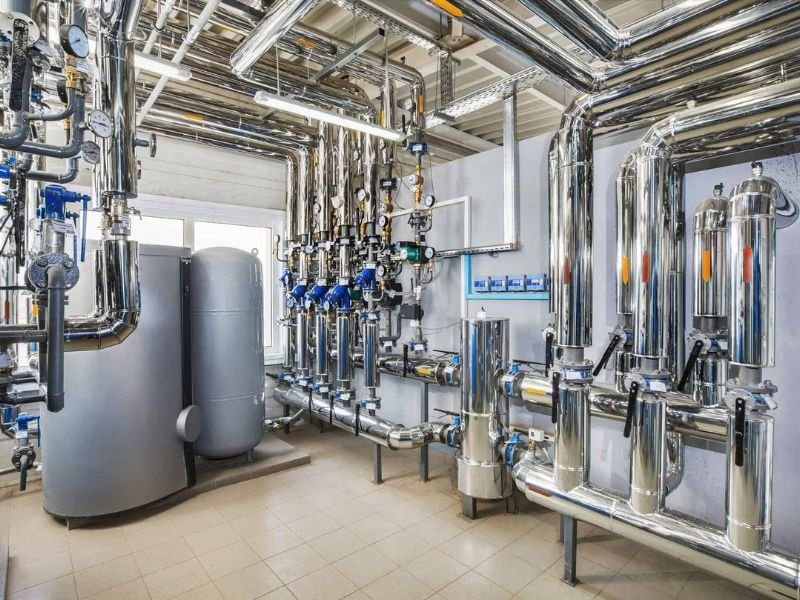
Boilers are heating devices that use heat to produce steam. They serve to heat water, generate electricity, and provide a source of hot air. These devices play a key role in various industries.
Are you searching for information about boilers? You’re in the right place. This article offers a comprehensive guide, covering their definition, types, components, and applications.
A boiler is a closed vessel in which water or other suitable liquid is heated and converted into steam. This steam is extracted and used for various purposes, such as heating applications (water heating, central heating). The boiler concept is used in a variety of applications, from domestic to industrial. Steam is produced by combining combustion products and water.
There are many types of boilers depending on their purpose. Domestic boilers, being small in size, are used for everyday household purposes. Industrial boilers also play an important role in the production process. Industrial boilers can be environmentally friendly, using natural gas or other non-hazardous fuels. Domestic and industrial boilers serve different purposes. Many industries are powered by industrial boilers.
In short, industrial boilers are energy powerhouses for powering industrial processes. They have become a vital component for many sectors.
A key component of the production system is the boiler, which includes the combustion air system, exhaust gas removal system, feedwater system, and fuel supply. The components of a boiler are as follows:
Boilers have wide applications in various industries which include-
There are basically two types of boilers: water-tube and fire-tube. The difference between boiler types is which side of the boiler tube contains the boiler water/steam or combustion gases.
A firetube boiler is a type of boiler in which combustion gases pass through the boiler tubes and heat is transferred to the water between the tubes and the outer casing. Large firetube boilers with capacities exceeding 1,500 boiler horsepower are typically firetube boilers. These boilers are identified by their number of passes, which represents the number of times the combustion gases travel through the length of the pressure vessel. The zone is either dryback or waterback. In a waterback design, the turnaround zone is water-cooled, so there is no need for a refractory lining. In a dryback design, refractory lining is required.
A watertube boiler is one in which the boiler water passes through tubes and the exhaust gases are directed towards the casing. The large chamber of the firetube can typically withstand higher internal pressures than the casing. Watertube boilers are used when high steam pressures are required. Watertube boilers can produce saturated steam with high efficiency. The ability of watertube boilers to produce truly superheated steam makes them attractive in applications that require high-pressure, high-energy, and dry steam. The characteristics of watertube boilers make them highly suitable in process industries such as pulp and paper manufacturing, chemical manufacturing, and refining. Firetube boilers account for a majority of boiler sales, and watertube boilers also account for a majority of boiler capacity.
Waste heat recovery boilers can be of firetube or watertube design. They use heat to generate steam, otherwise the heat would be lost. Typical heat sources include chemical manufacturing, refineries, and combustion of high-temperature products from external manufacturing processes.
Heat recovery steam generators transfer energy from the gas turbine exhaust to a fired heat-recovery steam generator, which produces steam. The exhaust gases exit the gas turbine at a high temperature. The energy can be recovered by heating the gases to produce hot water for process needs.
There are various types of boilers; you need to decide which type of boiler you need based on your production needs. Boilers are used for different purposes. Boilers are classified according to fuel and water holding capacity, amount of pressure generated, shell axis, boiler position, method of circulation, drum type, dry nature, and boiler application.
Electric boilers are one of the most popular boiler types, being efficient and environmentally friendly. This is primarily because they don’t require fossil fuels, resulting in lower carbon emissions. Unlike other boilers, their best advantage is that they don’t produce exhaust fumes and require less space than others. They are widely used by rural users. They have low installation costs and are quiet. Along with their advantages, they also have the disadvantage of being powered by electricity, which consumes a significant amount of power.
Condensing boilers are unique. They operate in a unique way. Their use of natural gas and two heat exchangers makes them one of the most efficient boilers. They extract heat from waste gases. They are capable of achieving thermal efficiencies of up to 98%. These boilers are now replacing other boilers for central heating. With two heat exchangers helping to reduce waste and costs, they are considered the most durable boilers, according to experts.
Oil boilers are those that are fueled by oil. Typically, oil-fired boilers have an efficiency of 86%. Oil-condensing boilers are the most efficient, at 90%. They use oil, not natural gas, as fuel. The oil is ignited in a combustion chamber and then heats cold water in a heat exchanger. These are commonly used to provide hot water to taps, radiators, or showers in homes.
Natural gas boilers, as the name suggests, use natural gas. Thermoelectric components are used to reduce fuel waste. The gas ignites the pilot, which heats the coils in the boiler. Propane gas is used in rural areas.
Source: Read about the boiler System



Read in 4 min
Read in 4 min

Read in 4 min